Be safe on the water
Six simple habits keep paddlers safe. Read them before every trip, and take a Paddle SA course to learn safety and rescue skills on the water.
- Wear a lifejacket
- Let someone know
- Keep clear
- Check the weather
- Carry communication
- Be seen, be safe
Wear a lifejacket
Being safe on the water starts with always wearing your lifejacket. A properly fitted lifejacket feels snug and comfortable to wear. Find one that suits you and your needs.
Let someone know
Before you go, tell someone where you are going, your departure point and when you plan to return. If you change your plans, let them know.
Keep clear
Stay clear of large vessels and keep out of shipping channels. Learn the right of way rules. Always navigate on the right (starboard) side of a river or channel.
Check the weather
Check five things when planning your trip: warnings for your paddling area, weather, wind, waves and tide times. Be ready to go another day if the wind is too strong or the waves too big. Check the forecast at bom.gov.au/marine.
Carry communication
You may need to call for help or tell someone your plans have changed. Options range from a mobile phone to flares or a distress beacon. Carry your mobile phone in a waterproof bag.
Be seen, be safe
Paddle craft sit low in the water and can be hard for other boats to see. Wear bright clothes, put reflective tape on your paddle, consider fitting a flag to your craft, and use a bright all-round light at night.
Kayaking and canoeing safety
Think about safety before and during every paddle in a kayak, canoe or similar unpowered craft. Be mindful of how your craft is affected by the weather and other risks such as capsizing, being blown off course, taking on water and not being seen by larger, faster boats.
As the paddler, you are responsible for your own safety and the safety of anyone else in your canoe or kayak. If you are paddling with a group, keep an eye on how everyone is going so no one ends up stressed or in danger.
Before you head out, check your safety equipment and take water, snacks, sunscreen and a phone. Tell friends or family who are not coming where you will be and when you plan to return. Know the weather and how it will affect your paddle.
Paddle Safe DVD - available from the Boating Safety Unit, 13 Kateena Street, Regency Park. dpti.recreationalboatingunit@sa.gov.au · 1300 183 046
Planning to paddle
Take a Paddle SA on-water course
Our courses give you the information you need for canoeing, kayaking, safety and rescue. They run at the Aquatic Reserve, Bower Road, West Lakes. The next course dates are listed on this page.
Wear your lifejacket (PFD)
Expect to capsize and swim now and then when paddling. Learn about PFDs and how they might just save your life.
Rules of the water
What paddlers need to know when sharing the waterways.
Safety check
Make a list of what you need to do before and during your paddles.
Water qualityRain, run-off and staying healthy
Paddlers don't often think about water quality before getting into their boat, but depending on your type of paddling it is worth some thought. Heavy, sustained rain or storms can affect water quality. In both city and country areas there is a higher risk of human and animal waste getting into waterways, where it can harm people using the water. Storm and rain run-off can also wash chemicals and road grime into waterways used for paddling.
Paddling is usually secondary contact with the water. Some paddling, such as white water, slalom, kayak surfing and canoe polo, may be primary contact (see the definitions below).
Please note: primary contact water activities should be limited after heavy, sustained rain or storms where more than 10 mm of rain has fallen.
All recreational water may contain pathogens, including lakes, rivers and the sea. Pathogens can enter the body through the eyes, ears, nose or throat, or through cuts and grazes. Common infections from poor quality water are eye, ear, nose or throat infections, and swallowing it can cause gastroenteritis. Some water-borne pathogens can cause serious infection, illness or even death.
Simple ways to protect yourself
- Check rainfall records for up to 5 days before paddling, and limit yourself to secondary contact after significant rain (more than 10 mm)
- After a swim, rinse your skin with clean water, especially your head and around your eyes, ears, nose and mouth
- Protect your ears from infection with a few drops of surgical alcohol in each ear after paddling where your head went under
- If you swallow any water, rinse your mouth with good quality drinking water
All paddlers should use common sense in deciding when and where to paddle.
Definitions
- Primary contact (whole body contact): the whole body, or the face and trunk, are often under water or the face is often wet with spray, and some water is likely to be swallowed or inhaled, or reach the ears, nose, mucous membranes or cuts (for example swimming, diving, surfing or white water canoeing).
- Secondary contact (incidental contact): only the limbs are regularly wet and greater contact, including swallowing water, is unusual (for example boating, fishing or wading), including occasional falls into the water by slipping or being knocked in by a wave.
- Pathogens: biological agents such as viruses, bacteria, prions or fungi that cause disease. Commonly known as germs.
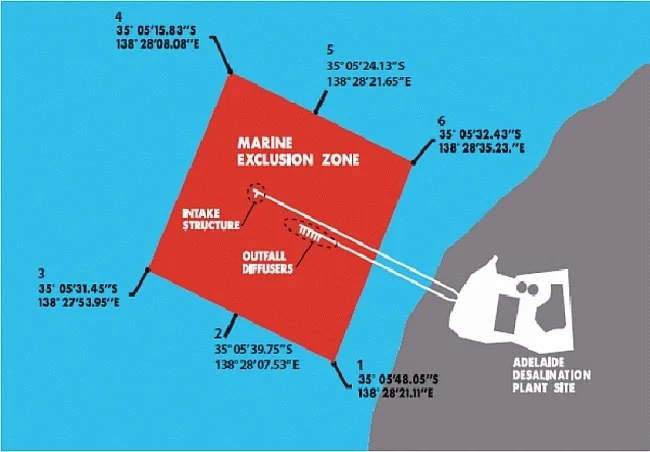
Permanent exclusion zone - Adelaide Desalination PlantMarker buoys and coordinates
Six marker buoys mark the boundaries of a permanent exclusion zone that came into effect on Monday 15 August 2011. Each buoy is lit, yellow, with a St Andrews cross topmark and a range of 3 nautical miles. Coordinates are in WGS 84 datum:
- No 1: 35° 05′ 48.05″ S, 138° 28′ 21.11″ E - flashing yellow every 3 seconds
- No 2: 35° 05′ 39.75″ S, 138° 28′ 07.53″ E - flashing yellow (2) every 10 seconds
- No 3: 35° 05′ 31.45″ S, 138° 27′ 59.95″ E - flashing yellow every 5 seconds
- No 4: 35° 05′ 15.83″ S, 138° 28′ 08.08″ E - flashing yellow every 5 seconds
- No 5: 35° 05′ 24.13″ S, 138° 28′ 21.65″ E - flashing yellow (2) every 10 seconds
- No 6: 35° 05′ 32.43″ S, 138° 28′ 35.23″ E - flashing yellow every 3 seconds
The south-east boundary is about 500 metres off the shore from the Adelaide Desalination Plant, leaving a channel for smaller vessels to pass between the coast and the zone. The zone keeps all mariners safe and protects the marine monitoring equipment and the intake and outfall structures inside it. Unauthorised vessels and people may not enter the area at any time.
The only exceptions are vessels used to maintain the intake and outfall infrastructure, the marine monitoring equipment or the navigation aids, and vessels doing marine monitoring.
A Notice to Mariners confirms the zone, and signs at boat ramps tell mariners about it. For more information call the Project Information Line on 1800 812 362, email desalination@sawater.com.au or visit sawater.com.au.